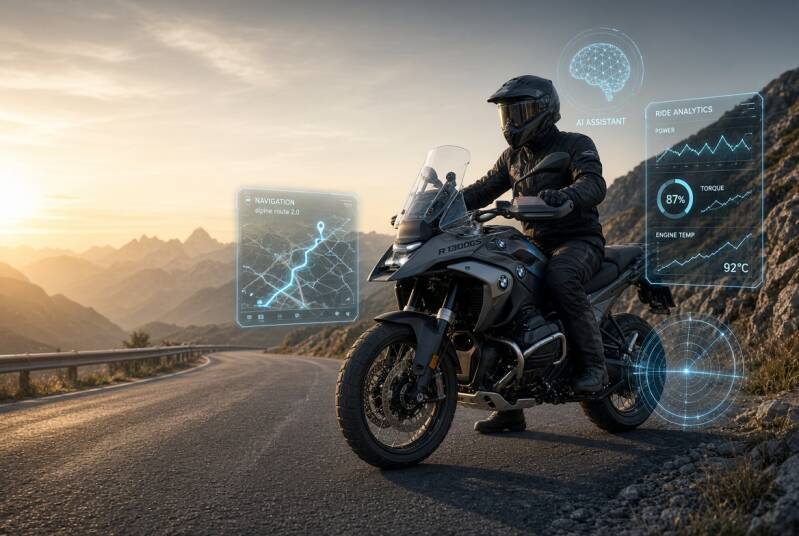
By 2026, your motorcycle will start to know you.
It will anticipate turns, warn you of hazards in your blind spot, and in some cases… it will even learn your riding style.
But between marketing hype and reality, how good are connected motorcycles and artificial intelligence today?
In this article, we'll take a clear, no-nonsense look at the facts.
What is a connected motorcycle? The 4 levels
Not all "connected" motorcycles are created equal. We can classify the technologies into 4 levels:
Level 1 – Basic connectivity
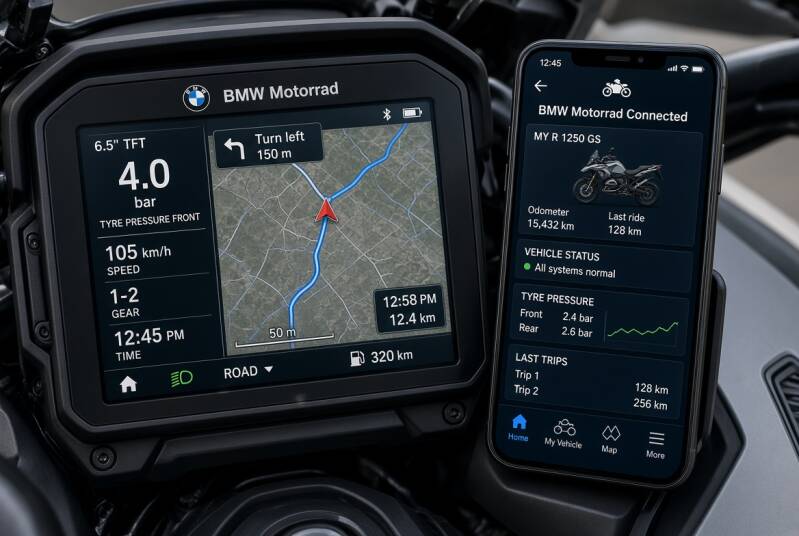
Bluetooth, navigation, music, calls… via the TFT screen and the manufacturer's app.
Level 2 – Vehicle data
Tire pressure, range, lean angle, trip history, predictive maintenance.
Level 3 – Active Rider Assistance Systems (ARAS)
Radar, adaptive cruise control, collision warning, blind spot detection (even when cornering).
Level 4 – Adaptive/Intelligent Systems
Anticipatory suspension, riding modes that adjust to your style, and soon, true onboard AI.
Today, most premium motorcycles fall between levels 2 and 3. Very few actually reach level 4.
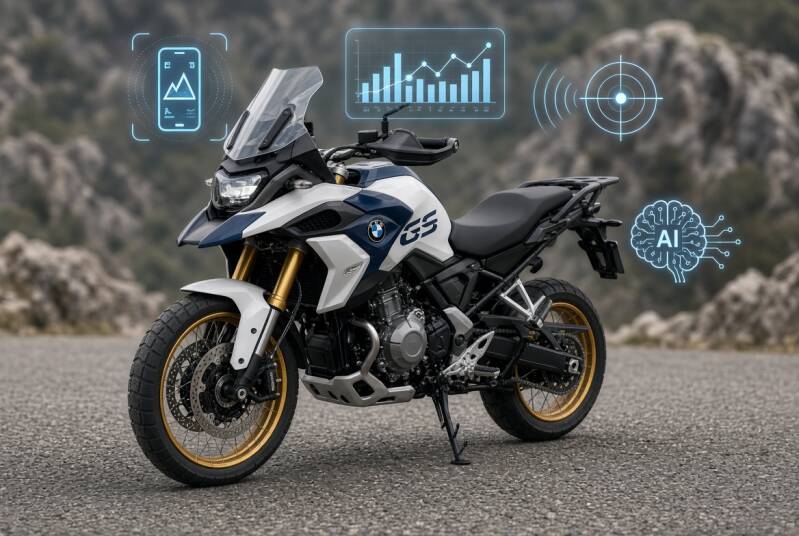
Key Technologies in 2026
1. The Connected Ecosystem
The most advanced example remains BMW ConnectedRide.
App + TFT screen + Multi-Controller: you control almost everything without taking your hands off the handlebars. Navigation, trip recording, performance data… it’s seamless and reliable.
2. Radar and Active Driver Assistance Systems
This is the major advancement of recent years.
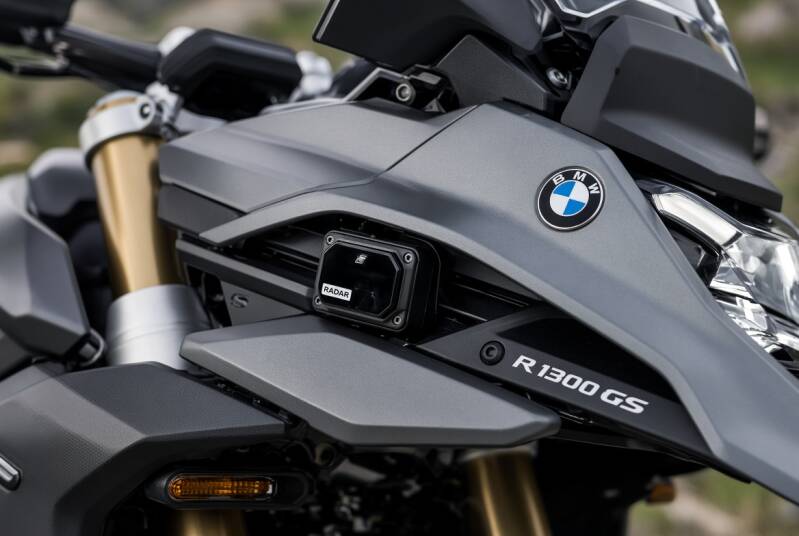
Adaptive cruise control, forward collision warning, blind spot detection… even on curves.
It doesn't replace your attention, but it can really help you avoid serious trouble.
3. Intelligent Suspension
At BMW, this is called Dynamic ESA or DSA.
The motorcycle adapts the damping in real time according to your riding style, load, and road type. On a GS, the difference is striking.
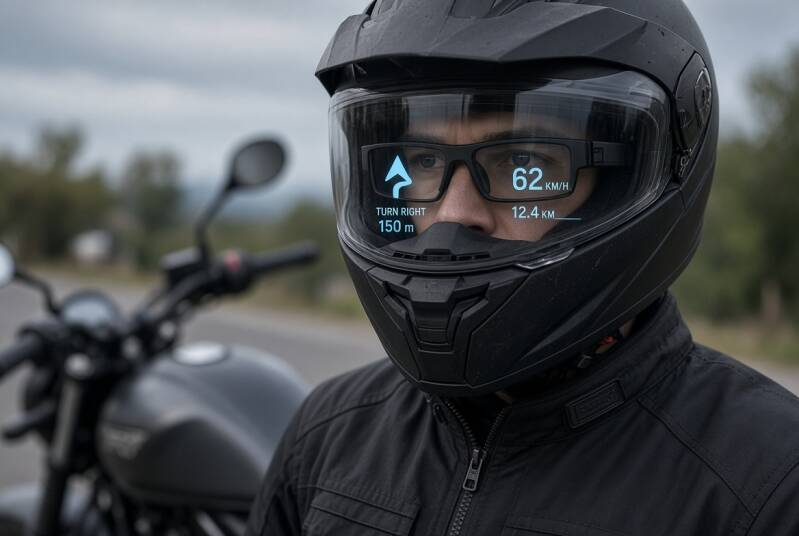
4. Smart Helmets and HUD
Navigation and alerts directly in your field of vision. Still room for improvement, but progress is rapid.
Focus on BMW: What they do best (and worst)
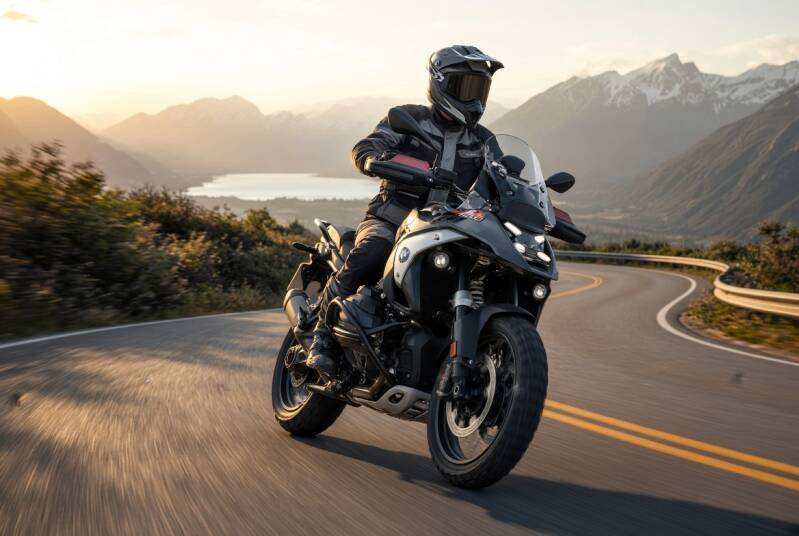
BMW isn't the most "wow" brand in marketing, but it's often the most consistent and accomplished in 2026.
Strengths:
• Very successful overall integration
• Riding Assistant (radar package)
• High-performance electronic suspension
• Automated Shift Assistant (ASA) on the R 1300 GS
ASA offers a semi-automatic mode (you shift gears, the clutch is managed) and a fully automatic mode. It's very pleasant for touring or riding in the city. For pure riding pleasure, it's more debatable.
Real Advantages vs. Limitations
The real advantages:
• Increased safety, especially when traveling and in bad weather
• Less fatigue on long journeys
• Better understanding of your own driving style
• More predictive maintenance
The limitations:
• The price of options (it adds up very quickly)
• Complexity: too much information can be distracting
• A certain dependence on electronics
• Driving feel sometimes a little too "filtered"
Technology remains a tool. It should never replace enjoyment or judgment.
Practical advice: what should you really get?
• You do a lot of driving and traveling → the radar package + electronic suspension are definitely worth it.
• You mainly ride for pleasure → take the time to think it over; you don't have to get everything.
Looking ahead (2027-2028), we should see systems that truly learn your driving style and much more advanced helmets. But we're still far from semi-autonomous riding.
Conclusion
The best connected motorcycle is the one you understand and can control.
Ajouter un commentaire
Commentaires